
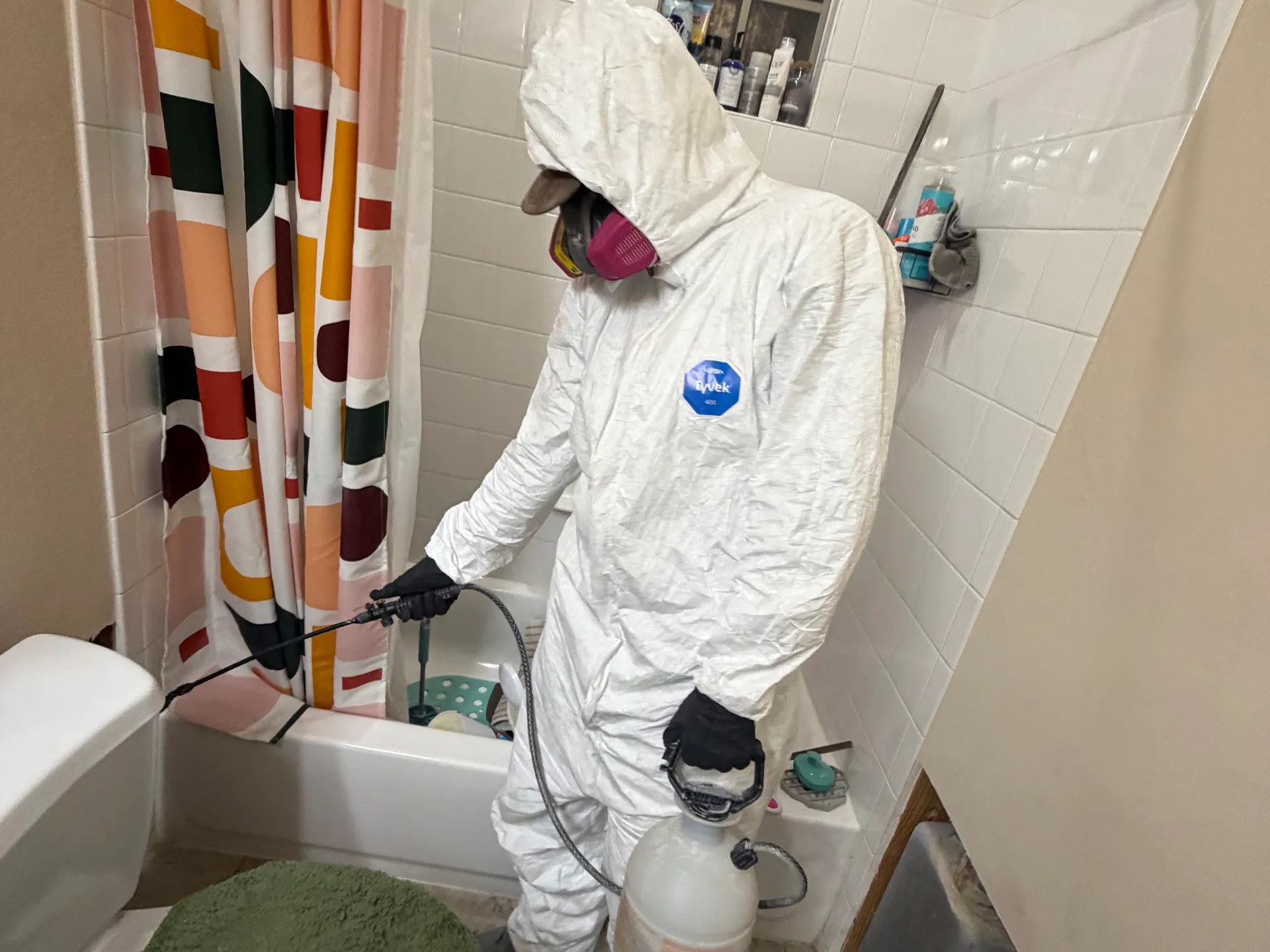
Mold removal and remediation
Residential Mold Remediation in San Antonio
Mold remediation for San Antonio homes, done in the right order: we contain the affected area, remove the mold, then clean and treat the surfaces it touched. And because mold always traces back to moisture, the water problem behind it has to go too.
How we handle mold
Safe containment
We close off the affected area before anyone disturbs the mold, so spores stirred up during the work stay in the work zone instead of drifting through the house.
Removal, not a cover-up
The mold comes out, along with porous material it has ruined. Spraying it or painting over it only hides it for a while.
Cleaning
Surfaces that stay get cleaned, and so does the area around the growth, where disturbed spores settle.
Treatment
Treatment of the affected areas comes after removal and cleaning. Never instead of them.
24/7 response
Mold is part of our 24/7 emergency response, along with water and fire damage. Call day or night.
Help with your insurance carrier
We help document the damage and work with your insurance carrier throughout the restoration process. The claim and the deductible stay yours.
Mold remediation vs. mold removal
Mold removal is the act of getting mold off a surface or out of a house. Mold remediation is the whole job around that act: containing the area, removing the mold and the materials it ruined, cleaning what stays, treating the affected areas and dealing with the moisture that let it grow. Some contractors call the same work mold abatement.
Which word you type into a search bar doesn't change much, since both lead to the same kind of company doing the same work. One distinction does matter: killing mold isn't the same as removing it. The EPA's guide to mold and moisture says dead mold may still cause allergic reactions in some people, so killing it isn't enough. It has to come out.
How our mold remediation works
Four steps, in a fixed order: containment, removal, cleaning and treatment, and none of them is optional, because each one protects the next. Skip one, and the job tends to move mold around instead of ending it. Size changes how long each step takes, not which steps happen.
One rule sits above all four. Wet materials have to dry. The EPA says no type of mold will grow without water or moisture, so if the walls or floors around the mold are still wet, drying comes first. Our structural drying service handles that part, using moisture monitoring to track the progress until the materials read dry.
Containment
Containment closes off the work area from the rest of the house before anyone touches the mold. Why start there? Disturbing mold releases spores. The EPA warns that even pulling down wallpaper with mold growing behind it can lead to a massive release of spores. Removal disturbs mold by design, so the area gets closed off first.
Without containment, those spores can drift into hallways, bedrooms and the return vents of your air conditioning. With it, they stay in the work zone. If we had to rank the four steps, this is the one we'd protect first, because it decides whether a bathroom mold problem stays a bathroom mold problem.
Removal
Removal is where the mold leaves the house, and on porous materials the material usually leaves with it. The EPA says mold can grow on or fill in the empty spaces and crevices of porous materials, and that you may have to throw away absorbent materials such as ceiling tiles and carpet once they turn moldy.
Drywall, insulation and carpet pad are porous too. We'd rather cut out a moldy section of drywall than scrub at a stain that keeps showing back up through the paint. Cutting it out looks like more work than a quick spray, and it is. It's also the version of the job that deals with the mold instead of decorating over it.
Cleaning
Not everything has to go. Hard, nonporous surfaces like tile, glass and metal can usually stay, and the EPA advice for them is plain: scrub the mold off with detergent and water, then dry the surface fully. That last part is the one people rush, and a surface left damp is where the next round of mold gets its start.
Cleaning also reaches past the patch you can see. Spores stirred up during removal settle on nearby surfaces, which is one more reason containment comes first. Keep the spores in a small zone and the cleanup stays small too. Let them roam, and the job grows room by room.
Treatment
Treatment of the affected areas comes last, after removal and cleaning, and it never replaces them. You'll see offers to spray mold and walk away. The trouble with that is simple: dead mold still has to come out, and no spray fixes the water that fed it. Ask anyone selling a spray-only job where the mold goes afterward.
Paint is the other shortcut to skip. The EPA says not to paint or caulk moldy surfaces and warns that paint applied over mold is likely to peel. Clean first, dry fully, then think about finishes. A fresh coat over a moldy wall just buys a season of looking fine.
Fix the moisture or the mold comes back
This is the part of mold remediation that decides whether you see the mold again. The EPA puts it bluntly: clean up the mold without fixing the water problem, and the mold problem will most likely come back. Its shorter version belongs on every fridge in Texas: the key to mold control is moisture control.
The usual sources are ordinary. A slow drip under a sink. An AC condensate line that backs up and soaks a closet ceiling halfway through a long cooling season. A roof leak that wets attic insulation for weeks before anyone checks. Indoor humidity matters as well. The EPA suggests keeping it below 60 percent, ideally between 30 and 50 percent.
Fixing the source is a repair for the right trade, like a plumber for a broken pipe. Drying what got wet is our side of it. If water is still standing, start with water damage restoration. If it's gone but the walls, floors or framing are still wet, structural drying gets them back to dry.
Do you need mold testing first?
Usually not. The CDC says it does not recommend mold testing, and that you do not need to know the type of mold growing in your home. If mold is growing, clean it up and fix the moisture problem. The EPA agrees that in most cases, when mold is visible, sampling is unnecessary.
The CDC's reasons are practical. Mold affects people differently, so a sample can't reliably predict who will get sick. Sampling can be costly. And no official standard defines an acceptable amount of mold in a home.
Testing also can't fix anything. Whatever a sample shows, the work is the same: contain the area, remove the mold, clean and treat what it touched, and deal with the moisture.
When a small patch is a do-it-yourself job
Not every mold spot needs a professional. The EPA says that if the moldy area is less than about 10 square feet (roughly a 3-by-3-foot patch), you can handle the job yourself in most cases by following its cleanup guidelines. Wear gloves and goggles, consider an N-95 respirator, and avoid breathing in spores. Using bleach? The CDC says never to mix it with ammonia or other cleaners. And if you have health concerns, the EPA says to consult a health professional before you start.
Past that size, or after a lot of water damage, the EPA points people to its more detailed remediation guidance instead of its basic cleanup guidelines. Other signs point past a do-it-yourself job, too: mold that keeps coming back after you clean it, mold inside a wall or under flooring, or someone at home with asthma or a weakened immune system. That's when containment earns its keep, and when a call to us makes sense.
Mold in attics, walls and HVAC systems
The mold you can see isn't always all of it. The EPA's list of hidden spots reads like a tour of a typical house. It names the back side of drywall, wallpaper or paneling, the top side of ceiling tiles, the underside of carpets and pads, and the inside of walls around leaking or condensing pipes. It also names the wall behind furniture, where condensation forms, plus ductwork and the roof materials above ceiling tiles.
A musty smell with nothing visible is a clue worth following. Attics deserve a look after any roof leak, since mold can grow up there for months before anyone notices. And if you suspect mold in your heating and air conditioning system, the EPA's guidance is direct: don't run the system if you know or suspect it's contaminated, because running it could spread mold through the building.
What mold remediation costs in San Antonio
Cost follows two things: how much area the mold covers, and how hard that area is to reach. Outside sources publish the industry averages below, and they give you a reference point before anyone prices your job. None of them is our price.
- Typical job, national
Industry average: $1,200–$3,750 per project from This Old House, which credits Angi for its cost data (updated March 11, 2026). - Per square foot, national
Industry average: $10–$25 per sq ft in the same This Old House guide. - Per square foot, San Antonio
Industry average: $10–$19 per sq ft on HomeBlue's San Antonio cost page, published in March 2022. Local, but older than the national figures.
Your own number depends on details no website can see: where the mold sits (an open bathroom wall versus a wall cavity, attic or crawlspace), how much material has to come out, and whether the area needs drying first. When you compare bids, ask whether containment and the moisture source are part of the job. A low number that leaves out either one isn't a bargain.
Mold and your insurance claim
Whether insurance pays for mold depends on how the water got there. The Texas Department of Insurance (TDI) says most homeowner and renters policies cover sudden and accidental water damage, and that mold developing on an item damaged in that kind of loss would fall under the coverage. Gradual leaks are another story. Most home policies don't cover water damage from gradual leaks or seepage, TDI says, and that includes mold.
TDI also notes that most home policies don't include mold cleanup and testing after a damaged item comes out, though your insurer may let you add coverage for cleanup caused by a covered loss. Your policy and your carrier decide what's covered, and we don't interpret policies. Our part: we help document the damage and work with your insurance carrier throughout the restoration process. The claim and the deductible stay yours, and our insurance claims page explains how that works.
Mold remediation across the San Antonio area
We're based in San Antonio and work across the metro, from inside Loop 410 to well past Loop 1604. Our San Antonio page covers the city itself. Nearby, we serve Converse in Bexar County, Cibolo in Guadalupe County, New Braunfels in Comal County and Boerne in Kendall County.
The town changes. The order of the work doesn't: containment, removal, cleaning, then treatment. If you're not sure your street is in range, call 24/7 and ask, and tell us what you're seeing while you're on the line. It helps to know roughly how big the affected area is, whether there's been a leak, and whether anyone at home has asthma or a weakened immune system.
Mold guidance at a glance
| Question | What the guidance says | Source |
|---|---|---|
| How fast can mold start growing after a leak? | Within a day. Dry water-damaged areas and items within 24 to 48 hours to prevent mold growth. | TDI; EPA |
| Do I need to know what type of mold it is? | No. Whatever type is present, remove it. | CDC |
| Should I test before cleanup? | CDC does not recommend mold testing. If mold is visible, sampling is unnecessary in most cases. | CDC; EPA |
| How big a patch can I clean myself? | In most cases, an area under about 10 square feet, following EPA cleanup guidelines. | EPA |
| Can I just kill the mold and leave it? | No. Dead mold may still cause allergic reactions in some people, so it has to come out. | EPA |
| What if mold is in the HVAC system? | Don't run the system if you know or suspect it's contaminated with mold. Running it could spread mold through the building. | EPA |
Why Texas Damage Response
Mold is a water problem that got a head start. We handle both halves: the water damage restoration that dries a house out, and the mold remediation that cleans up after moisture had its way. One company and one local number for both.
We're veteran-owned and operated, IICRC-certified and based in San Antonio, with 24/7 emergency response for water, fire, mold and other property damage. You'll notice this page cites the EPA, the CDC and TDI rather than asking you to take our word for things. Mold work attracts plenty of scare tactics. Plain facts serve you better.
Related services
Reconstruction
We rebuild what remediation had to remove.
Learn moreWater Damage Restoration
Extraction, structural drying and mitigation while the water is still the problem.
Learn moreStructural Drying
Drying walls, floors and framing, with moisture monitoring to track progress.
Learn moreEmergency Restoration
24/7 response when water, fire or mold damage can't wait.
Learn moreInsurance Claims
How we help document the damage and work with your carrier.
Learn more
Helpful guides
Mold remediation cost: industry averages and what changes the price
Mold remediation cost turns on how much area the mold covers, how hard it is to reach and what has to come out. The published averages, and how to read a quote.
Learn moreMold removal vs mold remediation: what's the difference?
Mold removal vs mold remediation: removal is one task, remediation is the whole job built around it. Texas Damage Response explains why the difference matters.
Learn more
Seeing or smelling mold?
Call 24/7, or send a request and tell us what you're seeing. We'll contain the area, remove the mold, and clean and treat what it touched.
Frequently Asked Questions
It can, if the moisture comes back. The EPA's mold guide says that if you clean up mold but don't fix the water problem, the mold problem will most likely return. No remediation leaves a house sterile, either. The EPA says a background level of mold spores will remain indoors, and those spores won't grow without moisture.
That puts the real test of a mold job in the months after it. Fix the leak, keep indoor humidity low (the CDC says no higher than 50 percent, all day long), and dry any new water damage fast. If walls or floors stay wet after a leak, structural drying with moisture monitoring is how they get back to dry.
Fast. The Texas Department of Insurance says mold can start growing within a day after a leak. The EPA advises drying water-damaged areas and items within 24 to 48 hours to prevent mold growth, and says that when wet materials dry within that window, mold won't grow in most cases.
That makes the first two days the whole game, and a weekend of waiting is long enough to matter. Stop the water if you can, get standing water out, and start drying. If water is still sitting in the house, our water damage restoration service covers extraction and drying, and our emergency response runs 24/7.
For cleanup, the color doesn't change the answer. The CDC says you do not need to know the type of mold, and that no matter what type of mold is present, you need to remove it. People usually mean Stachybotrys chartarum when they say "black mold," but plenty of common molds look dark, so color alone tells you little.
What matters more is how much mold there is, where it's growing and what's feeding it. If you can see or smell mold, the CDC's advice is to remove it and fix the moisture problem. And if anyone in your home has health concerns, talk to a doctor. We're a restoration company, not a medical one.
Sometimes. It depends on how big the affected area is, where it sits in the house, and who lives with you. Containment is what makes staying possible, because it closes the work area off from the rooms you're still using.
Health is the bigger factor. The CDC notes that people with asthma or mold allergies may have severe reactions, and that people with weakened immune systems or chronic lung disease may get lung infections from mold. If anyone in your home fits that description, ask their doctor before the work starts, and consider having them stay somewhere else until it wraps up. Before you decide, ask us how containment will work in your home.
It depends on the job, so be skeptical of anyone who names a number before they know how far the mold goes. Four things set the schedule: the size of the affected area, where it is (an open wall goes faster than a wall cavity, attic or crawlspace), how much material has to come out, and whether the area needs drying first.
Nobody can rush drying past the point where materials read dry, and the job doesn't end while the moisture source is still active. The sequence never changes, though. Containment, removal, cleaning and treatment happen in that order, whether it's one bathroom wall or a whole room.
Areas we serve
Based in San Antonio, we serve homes across the counties and cities below.