
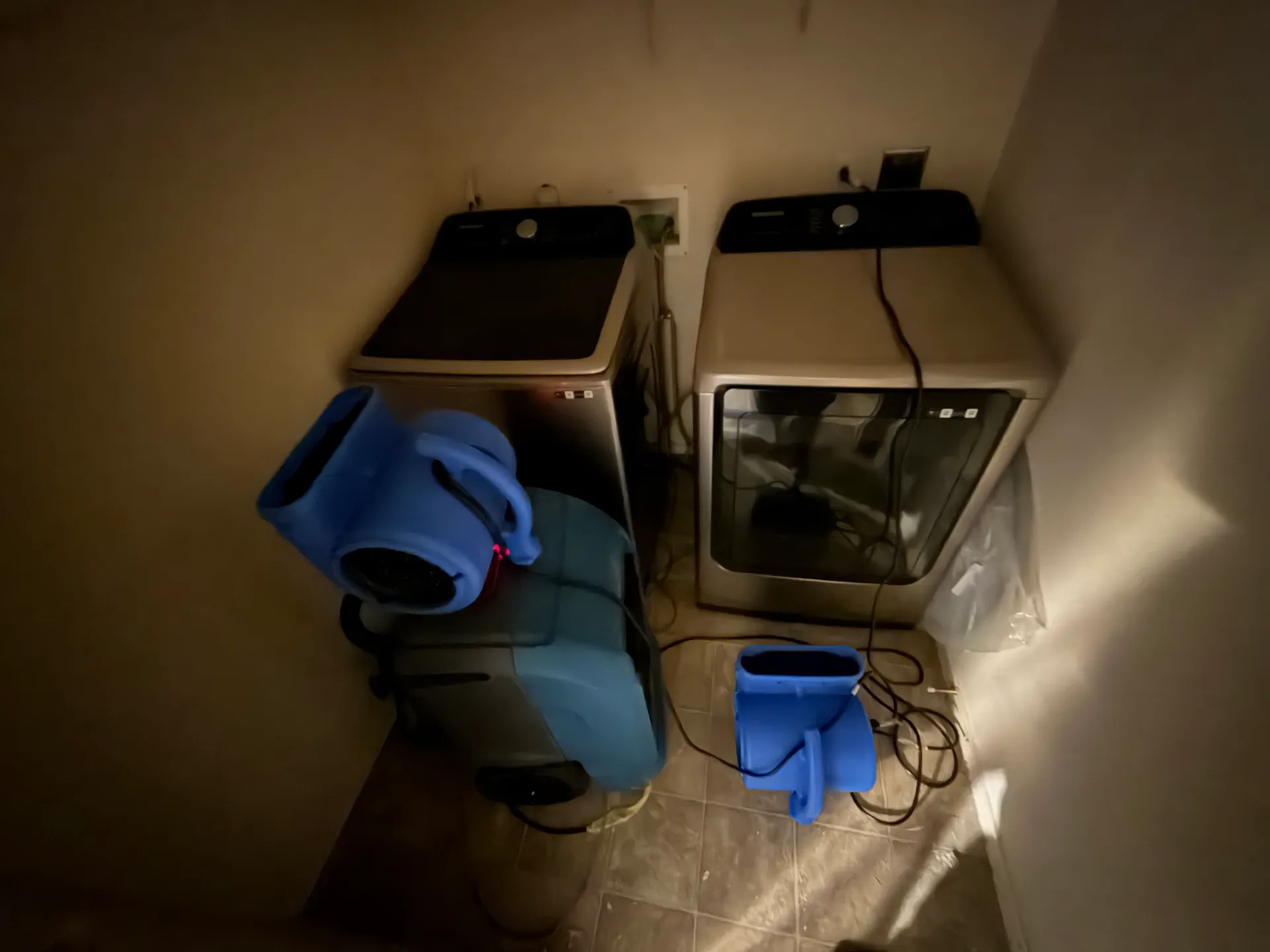
Laundry room water
Washing Machine Leak and Overflow Cleanup
A split washer hose or an overflowing drain can put water under the machine, through the wall and into the next room before the cycle ends. We extract it, dry the laundry room and everything around it, and track moisture until it's done.
What washing machine leak cleanup includes
Behind and under the washer
The water you can't see is usually under the machine and inside the wall behind it, so that's where we start measuring.
Next-door rooms checked
Bedrooms, hallways and garages that share a wall with the laundry room get moisture readings too.
Category 2 handled as Category 2
Washer discharge isn't clean water, and we treat porous materials it soaked with that in mind.
Extraction and drying
Standing water comes out first, then structural drying goes after the drywall, floors and framing.
Rebuild when it's dry
Cut drywall, swollen baseboards and ruined flooring go back in through our reconstruction team.
Claim documentation
We help document the damage and work with your insurance carrier throughout the restoration process.
Where washing machine leaks start
Most washer floods come from one of a handful of places, and knowing which one tells us a lot about how much water there is and how dirty it is.
- A supply hose splits or pops off. This is the big one. The hose is under house pressure all the time, so it keeps pouring until someone closes the valve, whether the washer is running or not.
- The drain hose slips out of the standpipe mid-cycle and empties onto the floor.
- The drain itself can't keep up or is clogged, so the standpipe overflows every time the washer pumps out.
- Something inside the machine fails, like a door seal, a pump or a cracked tub, and it leaks a little every load.
We don't fix any of those. An appliance technician or a plumber handles the washer, the hoses and the drain. We handle the water.
Washing machine water is Category 2
The industry standard for this work, the ANSI/IICRC S500, sorts water damage into three categories by source, and R&R Magazine's summary of those categories uses washing machines as its example for the middle one. Category 2 water contains significant contamination, and the examples include discharge from dishwashers or washing machines and overflows from washing machines.
So a washer that overflowed with a load of dirty clothes in it isn't a clean-water loss, even if it looks clear on the floor. That changes what we're willing to save. Carpet pad and drywall soaked by Category 2 water get a much harder look than the same materials after a clean supply-line leak.
Where the water came from matters, though. If the supply hose burst before the water ever reached the drum, that water came from a sanitary source, which is Category 1. And Category 3, the grossly contaminated kind, comes from sources like sewage. If what came up through the standpipe was a sewer backup, it's Category 3 water and a different job, covered on our sewage backup cleanup page.
Laundry rooms sit next to everything
Builders tuck laundry rooms wherever they fit: between the garage and the kitchen, down the hall from the bedrooms, sometimes upstairs. That's convenient for laundry. It's terrible for leaks.
Water spreads under the washer and dryer, slides under the shared wall's bottom plate, and shows up as a wet carpet edge in the bedroom next door or a stain on the garage side of the drywall. A second-floor laundry room sends it down instead, and our ceiling water damage page covers what that looks like from below. Either way, the laundry room floor is only the starting point for the moisture readings.
What to do right now, and what we do next
- Close the valves. The hot and cold valves behind the washer stop a burst hose. The Texas Department of Insurance tells homeowners to know how to turn off the water at the main and at the valves near appliances. If those won't close, shut off the main.
- Leave the plug alone if you're standing in water. The CDC says never to turn power on or off yourself while standing in water. Unplug the washer only from dry ground, or switch off its circuit at the breaker if you can reach the panel without wading.
- Photos before cleanup. TDI says to take pictures or video of the damage before making any repairs, if you can.
- Call us, 24/7. Our crew shows up ready to work on the first visit: water extraction, moisture mapping into the surrounding rooms, then structural drying with monitoring until the readings say it's dry.
Speed matters here. The EPA says to dry water-damaged areas and items within 24 to 48 hours to prevent mold growth. Behind a washer, in a closed-up laundry closet, damp drywall can sit unnoticed well past that.
Insurance after a washer hose breaks
TDI's own list of sudden and accidental water damage includes a broken washer hose, and it says most homeowner and renters policies cover that kind of damage. A machine that has been leaking a little every load for months is a different story, because policies usually won't cover damage from gradual leaks.
Your carrier decides which one it is and what it pays. We help document the damage and work with your insurance carrier throughout the restoration process, but we don't interpret policies or act as your adjuster, and your deductible still applies. The insurance claims page lays out how we work with carriers. We take these calls in Converse, Schertz, Canyon Lake and across the area.
Related services
Water Damage Restoration
Emergency water extraction, structural drying, moisture monitoring and complete mitigation for San Antonio homes, 24/7.
Learn moreWater Extraction
Standing water out of floors, carpet and pad, 24/7, before it soaks in any deeper.
Learn moreStructural Drying
Air movement, dehumidification and moisture monitoring that dry walls, subfloors and cabinets to a measured finish line.
Learn moreBurst Pipe Water Damage
Extraction, drying and moisture monitoring after a burst or frozen pipe.
Learn moreCeiling Water Damage
Stained, sagging or dripping ceilings dried from above, then rebuilt and painted.
Learn moreWater-Damaged Drywall
Wet walls measured, cut out where they can't be saved, dried to the studs and finished again.
Learn moreHardwood Floor Water Damage
Wet hardwood extracted, dried and measured board by board to save what can be saved.
Learn moreWater Heater Leak
Water out of the garage, closet and walls after a water heater leaks or lets go.
Learn moreAC Leak Water Damage
Ceilings, walls and floors dried and repaired after an AC drain line or pan overflows.
Learn moreFlood Damage Cleanup
Floodwater from outside cleaned out, contaminated materials removed, and the house dried, 24/7.
Learn moreSewage Cleanup
Sewer and drain backups contained, cleaned out, disinfected and dried, any hour.
Learn moreEmergency Restoration
The first steps after any water emergency, and how to reach us any hour.
Learn moreWater Damage Repair
Drywall, baseboards and flooring rebuilt after the laundry room is dry.
Learn moreInsurance Claims
How we document a washer leak for your carrier, and what stays your call.
Learn more
Helpful guides
Does homeowners insurance cover water damage? What TDI says
Does homeowners insurance cover water damage? TDI says most policies cover sudden leaks, not slow ones or floods. Texas Damage Response explains the details.
Learn moreHow to choose a restoration company after water or fire damage: questions to ask
How to choose a restoration company: Texas Damage Response's checklist of questions to ask, what to get in writing and the Texas rules on deductibles.
Learn moreRenters and water or fire damage: what renters insurance usually covers
Does renters insurance cover water damage or fire damage? TDI says it usually covers your belongings, not the building. We explain what to check and do first.
Learn more
Frequently Asked Questions
Usually, yes. The IICRC S500 treats discharge from washing machines and washing machine overflows as Category 2 water, which contains significant contamination. That's true even when it looks clear.
Water from a supply hose that burst before reaching the drum is different. It came from a sanitary source, so it starts out as Category 1. Either way, water that sits in a warm house can get worse with time.
No. We never repair or service appliances, and we don't do plumbing. An appliance technician or plumber fixes the washer, hoses or drain.
What we do is everything after that: extraction, drying, moisture monitoring and, once it's dry, the rebuild through our reconstruction team.
Sometimes the carpet can, but the pad underneath rarely makes it after Category 2 water. Pad soaks up water like a sponge, and it's hard to dry and clean well enough to trust.
How long the water sat matters too. If mold has already started, that part of the job becomes mold remediation.
Areas we serve
From our San Antonio base, we clean up washing machine leaks and overflows across these counties and cities.
Washer leaked across the floor?
Close the valves behind the machine and call us 24/7. We'll dry the laundry room and check every room the water could have reached.