
When the water comes in from outside
Flood Damage Cleanup in San Antonio
When a creek, a street or a yard floods into your house, the water carries whatever it ran through. We pull it out, remove the carpet, drywall and insulation it soaked, clean and disinfect what stays, and dry the structure, 24/7.
What flood damage cleanup includes
24/7 response
Once authorities say you can go back in, call any hour. The crew shows up ready to start on that first visit.
Floodwater and mud out
Standing water, silt and debris come out of every room the flood reached, including garages and closets.
Contaminated materials removed
Carpet, pad, soaked drywall, insulation and baseboards that floodwater reached get cut out and hauled off.
Cleaning and disinfecting
Slab, studs and other hard surfaces that stay in the house are cleaned and disinfected before drying starts.
Structural drying with readings
Moisture readings track the framing and slab until they reach a dry standard, so rebuilding starts on dry materials.
Records for your carrier
We help document the damage and work with your insurance carrier throughout the restoration process. Your carrier decides coverage.
Floodwater from outside needs a different cleanup
A burst pipe fills a room with tap water. When a creek jumps its banks or a street drain backs up into the yard and under the door, the water that crosses your threshold has already run through streets, lawns, storm drains and sometimes sewer lines.
The industry standard for water damage work, the ANSI/IICRC S500, puts that water in its most serious group. As Restoration & Remediation magazine summarizes it, Category 3 water is grossly contaminated and can contain pathogenic, toxigenic or other harmful agents, and the examples include ground surface water and rising water from rivers or streams.
That category changes the job. With a clean-water leak, a lot of carpet and drywall can be dried in place. Floodwater cleanup leans the other way: what the water soaked usually comes out. If your water came from a pipe, an appliance or a water heater inside the house, our water damage restoration page is the better fit.
Before you go back into a flooded house
Your belongings can wait a few more hours. Get the basics right first:
- Wait for the all-clear. Ready.gov says to return home only when authorities say it is safe, and not to walk, swim or drive through flood waters.
- Treat the power as live. Ready.gov also warns against touching electrical equipment if it is wet or if you are standing in water. If the panel sits in a wet garage, leave it for an electrician or the utility.
- Keep kids and pets out. The CDC notes that floodwater may contain sewage, other germs and contaminants that can lead to illness, and sharp debris like glass or metal. It says not to let children play in floodwater areas.
- Photograph everything before anything gets moved or thrown out. Wide shots of each room, then close-ups of the waterline on the walls.
Then call us. We work 24/7, and the crew arrives ready to work, so the cleanup starts on the first visit.
What comes out after a flood, and why
Porous materials act like sponges, and after a flood they're full of the same water you were told not to wade through. The CDC's mold cleanup tips say to throw out anything that was wet with flood water and can't be cleaned and dried out completely within 24 to 48 hours. In a flooded house, that list usually includes:
- Carpet and carpet pad
- Drywall, cut out to a line above the high-water mark, since drywall wicks water up past where the flood stopped
- Wall insulation behind that drywall
- Baseboards, and often the bottom of cabinets and door casings
Hard surfaces get a different treatment. The slab, the studs, tile and other non-porous materials that stay in the house are cleaned and disinfected, then dried. We photograph the damaged materials before they go to the trailer, which matches the CDC's tip to photograph discarded items for your insurance claim.
Belongings get sorted, too. Hard furniture and keepsakes that can be cleaned may be salvageable, and our contents pack-out crew can wrap, inventory and store them securely while the house is torn out and dried.
Drying the structure after the tear-out
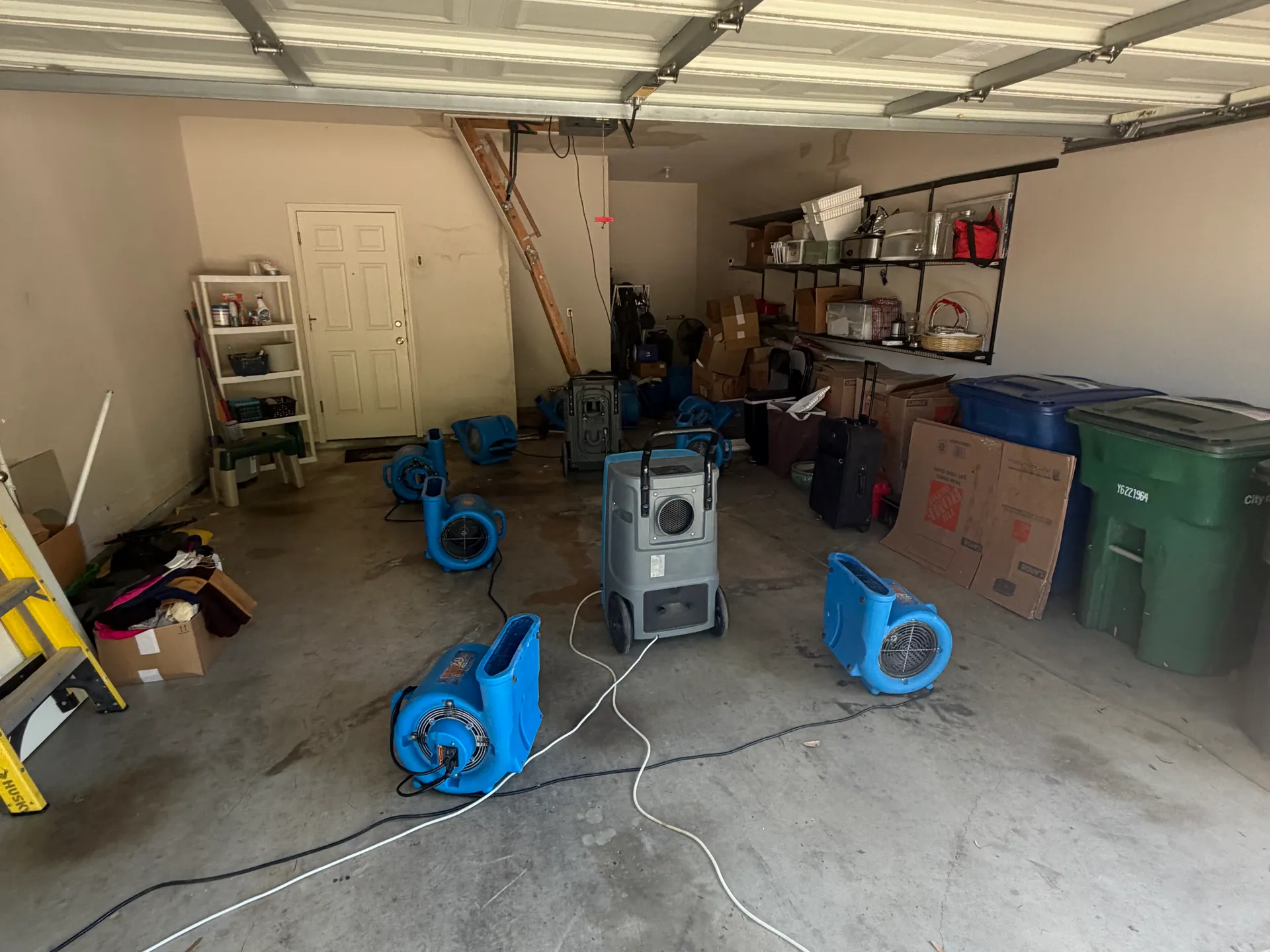
Opening the walls is what makes drying possible. With the wet drywall and insulation gone, air movers and dehumidifiers can reach the studs, the bottom plates and the slab. That's structural drying, and moisture readings run through the whole stretch so we know where the framing stands each day.
The EPA draws a firm line here: before refinishing and replacing walls and flooring, everything in the home needs to be completely dry to prevent future mold growth. We hold to the readings for that reason. If mold has already started on framing that sat wet too long, that area moves to mold remediation.
Once the house is dry, we can put it back. We rebuild the projects we restore, so new insulation, drywall, trim, paint and flooring go in through our reconstruction team instead of a second company you have to find.
Flash Flood Alley and the creeks around San Antonio
Heavy rain doesn't have far to go here before it runs off. The San Antonio Report describes much of the city as part of Flash Flood Alley, where shallow soil over limestone bedrock can't absorb much and creeks rise quickly in a heavy storm. Its April 2026 coverage recalled the June 2025 flood that swept vehicles off a Loop 410 access road near Perrin Beitel.
Homes near low-water crossings and creek beds tend to see it first, but street flooding can reach houses nowhere near a mapped floodplain. The Texas Department of Insurance points out that more than half of the homes flooded by Hurricane Harvey were outside designated flood zones. We clean up flooded homes from San Antonio out to the river and Hill Country towns, including New Braunfels, Canyon Lake, Seguin and Boerne.
Flood insurance is its own policy
This surprises a lot of homeowners after their first flood. According to the Texas Department of Insurance, your home insurance policy doesn't cover flood damage, and you need a separate flood policy, which TDI says you can get through the National Flood Insurance Program. Ready.gov says the same thing about homeowner's policies and adds that a flood policy typically takes up to 30 days to go into effect.
If you carry flood coverage, that carrier handles the claim. We help document the damage and work with your insurance carrier throughout the restoration process: photos, moisture readings and a record of what was removed. We don't interpret policies, negotiate claims or act as an adjuster. Your carrier decides what's covered, and the deductible stays yours. Our insurance claims page explains where we fit in.
Related services
Water Damage Restoration
Emergency water extraction, structural drying, moisture monitoring and complete mitigation for San Antonio homes, 24/7.
Learn moreWater Extraction
Standing water out of floors, carpet and pad, 24/7, before it soaks in any deeper.
Learn moreStructural Drying
Air movement, dehumidification and moisture monitoring that dry walls, subfloors and cabinets to a measured finish line.
Learn moreBurst Pipe Water Damage
Extraction, drying and moisture monitoring after a burst or frozen pipe.
Learn moreCeiling Water Damage
Stained, sagging or dripping ceilings dried from above, then rebuilt and painted.
Learn moreWater-Damaged Drywall
Wet walls measured, cut out where they can't be saved, dried to the studs and finished again.
Learn moreHardwood Floor Water Damage
Wet hardwood extracted, dried and measured board by board to save what can be saved.
Learn moreWater Heater Leak
Water out of the garage, closet and walls after a water heater leaks or lets go.
Learn moreWashing Machine Leak
Laundry room floods cleaned up and dried, including the rooms on the other side of the wall.
Learn moreAC Leak Water Damage
Ceilings, walls and floors dried and repaired after an AC drain line or pan overflows.
Learn moreSewage Cleanup
Sewer and drain backups contained, cleaned out, disinfected and dried, any hour.
Learn moreStorm Damage Restoration
Interior water damage from roof leaks, wind-driven rain and storm flooding.
Learn moreContents Pack-Out
Salvageable belongings wrapped, inventoried and stored securely while the house is torn out and dried.
Learn moreWater Damage Repair
Insulation, drywall, trim and flooring rebuilt once the structure is dry.
Learn more
Helpful guides
Does homeowners insurance cover water damage? What TDI says
Does homeowners insurance cover water damage? TDI says most policies cover sudden leaks, not slow ones or floods. Texas Damage Response explains the details.
Learn moreHow to choose a restoration company after water or fire damage: questions to ask
How to choose a restoration company: Texas Damage Response's checklist of questions to ask, what to get in writing and the Texas rules on deductibles.
Learn moreRenters and water or fire damage: what renters insurance usually covers
Does renters insurance cover water damage or fire damage? TDI says it usually covers your belongings, not the building. We explain what to check and do first.
Learn more
Frequently Asked Questions
Small amounts in a garage, maybe. Floodwater is Category 3 water under the IICRC S500, and the CDC warns it may carry sewage, germs and sharp debris, so gloves, boots and eye protection are the minimum.
Once it reaches carpet, drywall or more than one room, the job grows fast: wet materials need to come out, hard surfaces need cleaning and disinfecting, and the framing needs to dry before anything gets rebuilt. That's the work we do, 24/7.
Usually not after an outside flood. The CDC says to throw out anything wet with flood water that can't be cleaned and dried completely within 24 to 48 hours, and carpet pad soaked with floodwater rarely meets that bar.
Carpet wet from a clean supply line leak is a different case and is sometimes dried in place. Our water extraction page covers that situation.
The Texas Department of Insurance says home policies don't cover flood damage and that you need a separate flood policy, such as one through the National Flood Insurance Program. Your agent or carrier can tell you what you have.
We help document the damage and work with your insurance carrier throughout the restoration process. Coverage and payment decisions belong to your carrier, and your deductible applies.
It depends on how high the water got, how many rooms it reached and what has to come out. Tear-out and cleaning come first, then drying, which ends when moisture readings say the materials are dry rather than on a set date.
We can walk you through the order of work on the first visit, and our restoration process page lays out each step.
Areas we serve
From our San Antonio base, we handle flood cleanup in homes across these counties and cities.
Floodwater got into your home?
Once authorities say it's clear to go back in, call us 24/7. We remove what the flood contaminated, dry the house and help document the damage.