
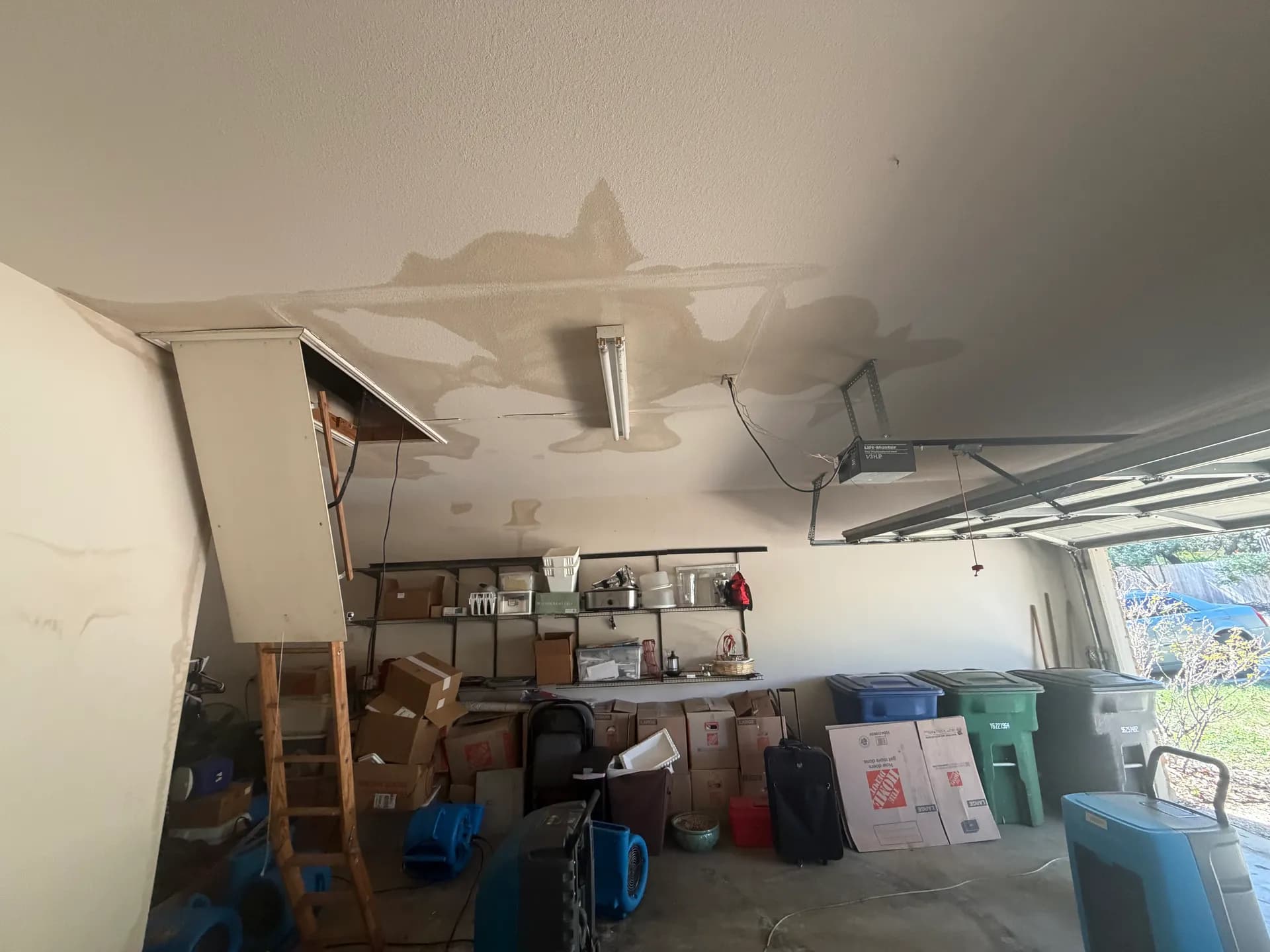
Leaks from above
Ceiling Water Damage Drying and Repair
A brown ring on the ceiling means water has been sitting where you can't see it. We find how far it spread, dry the ceiling cavity and the framing above it, then rebuild the drywall, 24/7 across San Antonio.
What ceiling water damage work includes
Tracing the wet area
Moisture readings show where the water actually traveled, which is rarely just the stained spot.
Sagging ceilings handled safely
A ceiling holding water gets drained and opened in a controlled way, with the room cleared first.
Insulation and joists
Wet insulation above the drywall holds water against the framing, so it gets checked and pulled if it's soaked.
Drying the cavity
Structural drying works on the space above the ceiling, not just the painted surface you can see.
Drywall, texture and paint
We rebuild the projects we restore, so the crew that dried the ceiling is the crew that patches and paints it.
Photos for your carrier
We help document the damage and work with your insurance carrier throughout the restoration process.
Signs of ceiling water damage
Ceilings hide water well. By the time you see a mark, the drywall has usually been soaking for a while, because water spreads across the top of the board before it shows through the paint.
Watch for these:
- Yellow or brown rings that grow, or come back after you paint over them
- Paint that bubbles, peels or hangs in a little pouch
- A soft spot, a crack along a drywall seam, or a ceiling that dips in the middle
- Drips at a light fixture, a vent register or a smoke detector, since water follows the holes
- A musty smell in one room that you can't pin down
One stain doesn't always mean one leak, either. Water runs along joists and pipes before it drops, so the mark can sit several feet from wherever the water came from.
A sagging ceiling is a warning, not a curiosity
Drywall that bows down is carrying weight it was never built for, and soaked drywall can give way. Keep people and pets out from under it. Move furniture and electronics out of the room if you can do it without standing beneath the sag. Don't poke it with a broom handle to "let the water out." That's how a slow drip becomes a room full of wet drywall and insulation.
If water is coming through a light fixture, treat it as an electrical problem first. The CDC says to turn off power at the main breaker, but not by walking through standing water to reach the panel. If you can't get there safely, call an electrician.
Find the source before anyone patches anything
Patching a ceiling before the leak is fixed is money spent twice. The usual suspects in a San Antonio house:
- An upstairs bathroom: a toilet supply line, a shower pan, or caulk that failed around a tub
- An attic air handler with a clogged drain line, which we cover on our AC leak water damage page
- A water line or a fitting running through the attic or between floors
- A roof leak after a storm
We don't repair roofs, plumbing or AC units. A roofer, plumber or HVAC technician fixes the source. Our part is everything the water reached on the way down, and we'll point out what we find while we're up there so the right trade knows where to look.
We take these calls from homes all over the region, from San Antonio and Cibolo up to Round Rock.
Drying the ceiling cavity, not just the drywall
The stain is only the part you can see. Above the drywall there's insulation, joists, maybe a subfloor from the room upstairs. Insulation soaks up water and presses it against the wood. If only the painted side gets dried, the framing can stay wet long after the stain looks better.
So the work starts with moisture readings across the ceiling and up into the cavity. Where the drywall is saturated or sagging, we open it, pull out wet insulation and let air reach the joists. Then structural drying takes over, and moisture monitoring tells us when the wood is actually dry. Dry to the touch doesn't count.
Timing matters here as much as anywhere. The EPA says to dry water-damaged areas and items within 24 to 48 hours to prevent mold growth, and it notes that porous materials such as ceiling tiles may have to be thrown away if they become moldy. If mold has already started in the cavity, the job moves to mold remediation.
Ceiling water damage repair: we rebuild what we open
Drying a ceiling means cutting into it sometimes. We don't leave you with a hole and a phone number for somebody else. We rebuild the projects we restore, so after the readings confirm the framing is dry, the same team hangs new drywall, tapes it, matches the texture as closely as the existing ceiling allows and paints.
That's reconstruction, and our operations manager, who is Xactimate-certified with more than six years in reconstruction, builds the estimate. The details of rebuilding after a leak are on our water damage repair page.
A perfect texture match on an old popcorn or knockdown ceiling isn't always possible on a small patch. Sometimes repainting the whole ceiling is what makes the repair disappear, and we'll tell you up front when that's the case.
Insurance and ceiling leaks
How the water got there shapes the claim. The Texas Department of Insurance says most homeowner and renters policies cover sudden and accidental water damage, and that policies usually won't cover damage from gradual leaks. A ceiling stain that's been growing for months can land on the wrong side of that line. Your carrier makes that call, not us.
TDI also says to take pictures or video of the damage before making any repairs, if you can. Do that before the ceiling comes down. We help document the damage and work with your insurance carrier throughout the restoration process. We don't interpret your policy or negotiate the claim, and your deductible is yours. Our insurance claims page walks through where we fit.
Related services
Water Damage Restoration
Emergency water extraction, structural drying, moisture monitoring and complete mitigation for San Antonio homes, 24/7.
Learn moreWater Extraction
Standing water out of floors, carpet and pad, 24/7, before it soaks in any deeper.
Learn moreStructural Drying
Air movement, dehumidification and moisture monitoring that dry walls, subfloors and cabinets to a measured finish line.
Learn moreBurst Pipe Water Damage
Extraction, drying and moisture monitoring after a burst or frozen pipe.
Learn moreWater-Damaged Drywall
Wet walls measured, cut out where they can't be saved, dried to the studs and finished again.
Learn moreHardwood Floor Water Damage
Wet hardwood extracted, dried and measured board by board to save what can be saved.
Learn moreWater Heater Leak
Water out of the garage, closet and walls after a water heater leaks or lets go.
Learn moreWashing Machine Leak
Laundry room floods cleaned up and dried, including the rooms on the other side of the wall.
Learn moreAC Leak Water Damage
Ceilings, walls and floors dried and repaired after an AC drain line or pan overflows.
Learn moreFlood Damage Cleanup
Floodwater from outside cleaned out, contaminated materials removed, and the house dried, 24/7.
Learn moreSewage Cleanup
Sewer and drain backups contained, cleaned out, disinfected and dried, any hour.
Learn moreWater Damage Repair
Drywall, texture, paint and the rest of the rebuild once the drying is done.
Learn moreAttic Mold Removal
For leaks that sat in the attic long enough for mold to start on the decking or framing.
Learn moreInsurance Claims
How our documentation fits your carrier's process, and where our role stops.
Learn more
Helpful guides
Does homeowners insurance cover water damage? What TDI says
Does homeowners insurance cover water damage? TDI says most policies cover sudden leaks, not slow ones or floods. Texas Damage Response explains the details.
Learn moreHow to choose a restoration company after water or fire damage: questions to ask
How to choose a restoration company: Texas Damage Response's checklist of questions to ask, what to get in writing and the Texas rules on deductibles.
Learn moreRenters and water or fire damage: what renters insurance usually covers
Does renters insurance cover water damage or fire damage? TDI says it usually covers your belongings, not the building. We explain what to check and do first.
Learn more
Frequently Asked Questions
Only after two things are true: the leak is fixed and the drywall and framing above it are dry. Paint over a wet ceiling and the stain bleeds back through, and you've hidden the evidence your carrier may want to see.
A moisture reading settles it. If the ceiling is still wet, it needs drying first, and if the drywall has gone soft or sagged, it needs replacing rather than painting.
It can. Drywall loses strength as it soaks up water, and a ceiling holding water plus wet insulation is heavy. Nobody can tell you from the floor how long it will hold.
Clear the room, keep everyone out from under it and call us 24/7 for emergency restoration. Our crew comes ready to work on the first visit, so the ceiling gets drained and opened under control instead of on its own schedule.
No. A roofer, plumber or HVAC technician repairs the source. We handle the water damage: finding how far it spread, drying the ceiling cavity and framing, and rebuilding the drywall and paint through our reconstruction service.
Get the source fixed as soon as you can. Drying a ceiling while water still drips into it doesn't get anyone anywhere.
Areas we serve
From San Antonio, we dry and rebuild water-damaged ceilings in homes across these counties and cities.
Water coming through the ceiling?
Stay out from under the wet spot and call us 24/7. We dry the ceiling and the framing above it, then put the room back together.