
24/7 water damage response
Water Damage Restoration in San Antonio
Water on the floor, a stain spreading across the ceiling, a water heater that just quit. Our water damage restoration gets the water out of your San Antonio home, dries the structure underneath and tracks the moisture until the readings say it's dry. Emergency response is available 24/7, and the work starts on the first visit.
How we handle water damage
Emergency response, 24/7
Pipes don't burst on a schedule. Emergency response is available day or night, weekends included, because water keeps spreading while you wait.
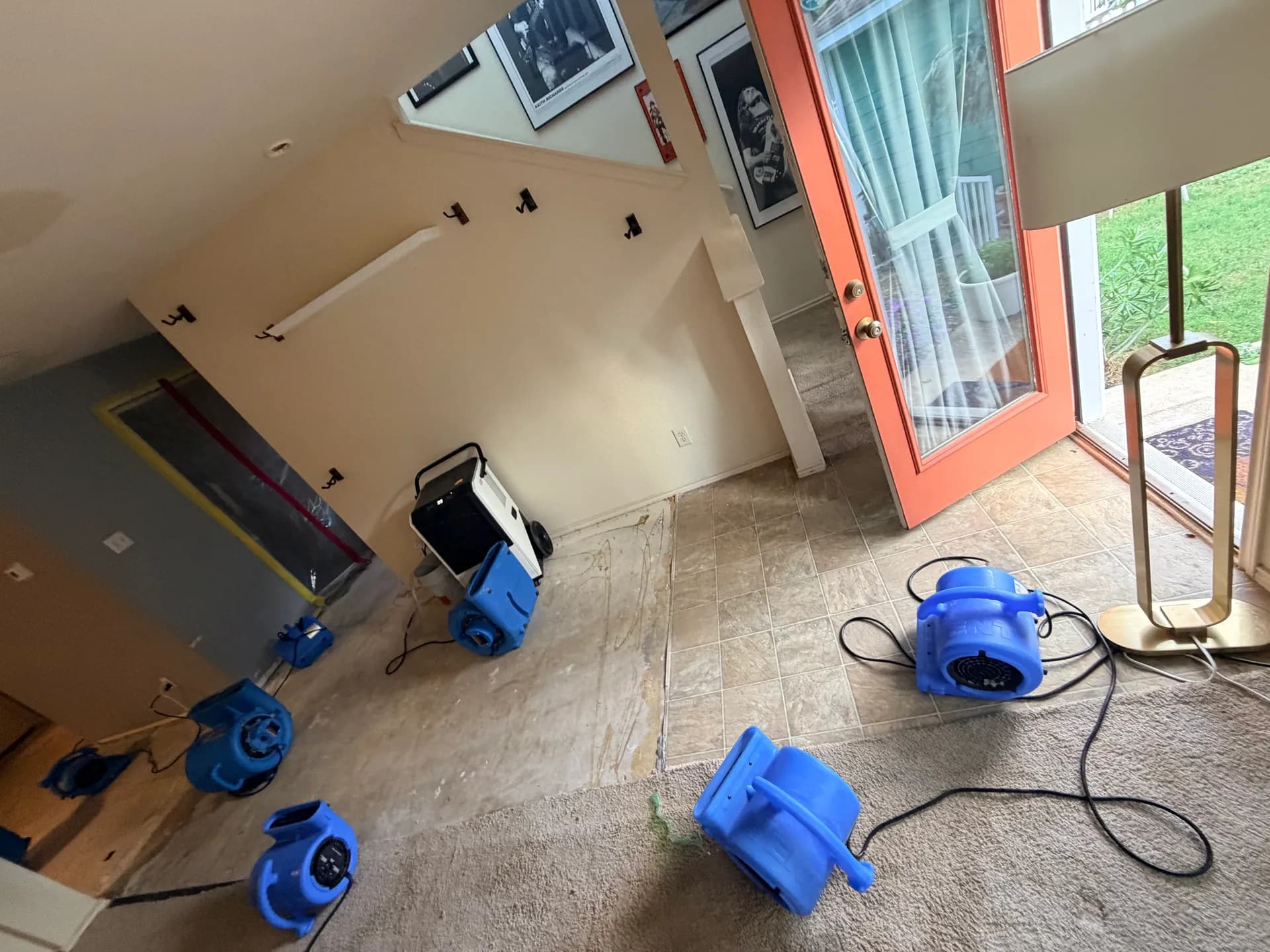
Emergency water extraction
Standing water comes out of carpet, pad and hard floors before anything else. The longer it sits, the deeper it soaks.
Structural drying
Drywall, subfloor and framing hold water long after the surface feels dry, so we dry the structure itself, not just the parts you can touch.
Moisture monitoring
Readings from the first visit to the last show where the water went and whether the materials have dried. The numbers decide when drying stops, not the calendar.
Complete mitigation
Everything that keeps a leak from turning into a bigger loss, from moving belongings off wet floors to protecting the rooms the water hasn't reached yet.
Help with insurance documentation
We help document the damage and work with your insurance carrier throughout the restoration process. Coverage decisions stay with your carrier.
Water Damage Restoration services
Water Extraction
Standing water out of floors, carpet and pad, 24/7, before it soaks in any deeper.
Learn moreStructural Drying
Air movement, dehumidification and moisture monitoring that dry walls, subfloors and cabinets to a measured finish line.
Learn moreBurst Pipe Water Damage
Extraction, drying and moisture monitoring after a burst or frozen pipe.
Learn moreCeiling Water Damage
Stained, sagging or dripping ceilings dried from above, then rebuilt and painted.
Learn moreWater-Damaged Drywall
Wet walls measured, cut out where they can't be saved, dried to the studs and finished again.
Learn moreHardwood Floor Water Damage
Wet hardwood extracted, dried and measured board by board to save what can be saved.
Learn moreWater Heater Leak
Water out of the garage, closet and walls after a water heater leaks or lets go.
Learn moreWashing Machine Leak
Laundry room floods cleaned up and dried, including the rooms on the other side of the wall.
Learn moreAC Leak Water Damage
Ceilings, walls and floors dried and repaired after an AC drain line or pan overflows.
Learn moreFlood Damage Cleanup
Floodwater from outside cleaned out, contaminated materials removed, and the house dried, 24/7.
Learn moreSewage Cleanup
Sewer and drain backups contained, cleaned out, disinfected and dried, any hour.
Learn more
How water damage restoration works
Water damage restoration runs in a set order, and the order is the whole point. Water comes out before drying starts. Drying gets measured, not eyeballed. And the damage gets photographed and written up before anything leaves the house.
- First, emergency water extraction gets the standing water out.
- Next comes mitigation, which keeps the loss from spreading to rooms and belongings that are still dry.
- With the bulk of the water gone, structural drying goes after the moisture inside drywall, subfloor and framing.
- Moisture monitoring runs the whole time. Readings, not a date on the calendar, tell us when the materials are dry.
Every job starts with an assessment, because a supply line leak in one bathroom and a water heater that flooded three rooms are different projects. A burst pipe follows the same steps. The pipe itself goes to a plumber, and we take care of the water it left behind.
Emergency water damage help, 24/7
Emergency water damage doesn't keep office hours, and neither do we. Emergency response is available 24/7, so a call at 2 a.m. starts the same sequence as a call on a Tuesday afternoon: stop the source, pull out the water, start the drying.
Speed matters more than it looks. The EPA advises drying water-damaged areas and items within 24 to 48 hours to prevent mold growth, and that clock starts when the water does, not when somebody finds it. Water from a dishwasher line that leaks overnight can wick into cabinets and subfloor before anyone's awake.
We don't publish arrival times, since distance, traffic and the jobs already underway all change them. Call and ask what to expect at your address. If the damage can wait, you can also request service online. Facing fire or mold instead? Our emergency restoration page covers the first steps.
Water mitigation vs. water damage restoration
Water mitigation is the first phase of the job: stopping the damage from getting worse. Restoration is the bigger goal of getting your home back to where it stood before the water got in, and mitigation is where that starts. You'll also hear water remediation, water restoration and water damage cleanup used for the same work. Plenty of companies treat the words as interchangeable, so don't let the vocabulary slow you down.
Our water damage service includes complete mitigation. In practice, that means isolating the water source, extracting standing water, moving furniture and belongings off wet floors, protecting the dry parts of the house and sorting wet materials into what can dry in place and what can't. If a room needs emptying, our contents pack-out service handles careful packing, an inventory, transportation and storage. Your things come back when the house is ready for them.
Hidden moisture and the mold clock
The puddle is the easy part. Water slides under baseboards, wicks up the bottom of drywall, fills carpet pad and spreads under vinyl plank and laminate, so the damage you can see usually covers less ground than the damage you have. The EPA's mold and moisture guide lists places mold can hide: the back side of drywall, wallpaper or paneling, the top of ceiling tiles, and the underside of carpets and pads.
That's why moisture monitoring sits at the center of our work. Readings at the start show how far the water traveled, and repeat readings during structural drying show whether it's leaving. And the clock is short. The Texas Department of Insurance notes that mold can start growing within a day after a leak. If it already has, mold remediation covers safe containment, removal, cleaning and treatment of the affected areas.
What Texas home insurance usually covers
Most homeowner and renters policies cover sudden and accidental water damage, according to the Texas Department of Insurance (TDI). A pipe that suddenly bursts usually fits that description. A slow drip under a sink that ran for months usually doesn't, since most home policies exclude gradual leaks and seepage, along with the mold that comes from them. Floods fall outside home policies altogether; TDI points homeowners to a separate flood policy.
Timing matters as well. TDI says you usually must report hidden water damage within days after you first see it, and it recommends photos or video before repairs. TDI also says to keep damaged items until your adjuster has seen them.
Our part is the paperwork. We help document the damage and work with your insurance carrier throughout the restoration process. We aren't adjusters and we don't interpret policies. Your carrier decides coverage, and the deductible stays your responsibility under your policy. Our insurance claims page goes deeper.
Choosing a water damage restoration company
Picking a restoration company at 2 a.m. leaves no time for research, and you don't need much. Four questions sort out the field.
- Can you come now? Emergency response should be available 24/7, nights and weekends included. Be skeptical of an exact arrival time promised before anyone knows your address.
- How will you know it's dry? Listen for moisture readings and a dry standard, not "it feels dry" or a set number of days.
- What will I have for my insurance carrier? Photos, readings and notes you can hand to your adjuster.
- Who decides what's covered? Your carrier. Anyone who promises a claim outcome, or offers to make your deductible disappear, is waving a red flag.
Our answers to all four are on this page, and we'll give them to you again over the phone.
San Antonio water damage: freezes, flash floods and everyday leaks
Most water damage starts with something ordinary. San Antonio adds two local twists: hard freezes that catch pipes unprotected, and rain that turns into flash flooding.
Freezes and burst pipes
After the February 2021 freeze, San Antonio Water System president and CEO Robert Puente put the count at about 100,000 water leaks across the city, according to the San Antonio Report. The January 2024 arctic blast burst pipes again, in homes and on San Antonio ISD campuses (Hoodline). SAWS posts freeze tips worth reading before the next cold snap. If a pipe goes anyway, the Texas Department of Insurance says to shut your water off at the main and move expensive items off the floor. Our burst pipe water damage page covers the cleanup from there.
Flash floods and everyday leaks
Much of San Antonio sits within “Flash Flood Alley,” where shallow soil and limestone bedrock limit how much rain the ground can take in, so creeks rise fast in a heavy downpour. The San Antonio Report laid that out in April 2026, recalling the June 2025 flood that swept vehicles off a Loop 410 access road near Perrin Beitel. Never walk or drive into moving water. Floodwater from outside counts as Category 3 under the industry standard, and a home policy doesn't cover floods. Our flood damage cleanup page covers how that work differs.
Inside the house, the causes look tamer: a water heater that gives out, a split supply line, an AC condensate line that backs up in August, a slab leak a plumber has to find. We work from San Antonio across Bexar County and nearby cities like Schertz, New Braunfels and Boerne.
Water categories: why the source matters
Where the water came from shapes the whole job. The ANSI/IICRC S500, the industry's Standard for Professional Water Damage Restoration, sorts water into three categories by contamination. The category tells you three things: how much is likely salvageable, how careful the work has to be and roughly where the cost lands.
Category 1 comes from a sanitary source, like a broken supply line. Category 2 carries significant contamination, the kind in washing machine or dishwasher discharge, and Category 3 is grossly contaminated and can carry pathogens. The table below pairs the S500 definitions, as summarized by Restoration & Remediation magazine, with national per-square-foot cleanup costs from Today's Homeowner. Those are industry averages, not our prices. Category 3 water is no job for a shop vac, so keep people and pets out of it. A sewage backup or floodwater gets its own process.
Water damage categories compared
| Category | What the S500 says | Typical sources in a home | National cleanup cost |
|---|---|---|---|
| Category 1 (clean water) | Comes from a sanitary water source | Broken supply lines, sink or tub overflows with no contaminants, appliance supply lines | Industry average: $3–$4 per sq ft |
| Category 2 (gray water) | Carries significant contamination and can cause discomfort or sickness | Washing machine or dishwasher discharge, some toilet bowl overflows, broken aquariums | Industry average: $4–$7 per sq ft |
| Category 3 (black water) | Grossly contaminated; can carry pathogenic, toxigenic or other harmful agents | Toilet backflows from beyond the trap, rising water from rivers or creeks | Industry average: $7 per sq ft and up |
Why Texas Damage Response
Texas Damage Response is a San Antonio restoration company, veteran-owned and operated, and water damage sits at the center of our work.
- Emergency response available 24/7, day or night
- IICRC certification, from the body that publishes the S500 water damage standard
- Extraction, structural drying, moisture monitoring and complete mitigation from one point of contact
- Help documenting the damage for your insurance carrier
- Mold remediation and contents pack-out, if needed
One company name and one local number, from the first call to the last moisture reading. What you won't get: an arrival time nobody can keep, or a guess about what your policy covers. Ask anything. Our restoration process page shows every step in order.
Related services
Reconstruction
When the structure is dry, we rebuild the drywall, floors and cabinets that came out.
Learn moreMold Remediation
Safe containment, removal, cleaning and treatment when a leak has already led to mold.
Learn moreContents Pack-Out
Careful packing, an inventory, transport and storage for belongings that need to leave a wet room.
Learn moreInsurance Claims
How we document water damage for your claim, and which decisions stay between you and your carrier.
Learn more
Helpful guides
Does homeowners insurance cover water damage? What TDI says
Does homeowners insurance cover water damage? TDI says most policies cover sudden leaks, not slow ones or floods. Texas Damage Response explains the details.
Learn moreHow to choose a restoration company after water or fire damage: questions to ask
How to choose a restoration company: Texas Damage Response's checklist of questions to ask, what to get in writing and the Texas rules on deductibles.
Learn moreRenters and water or fire damage: what renters insurance usually covers
Does renters insurance cover water damage or fire damage? TDI says it usually covers your belongings, not the building. We explain what to check and do first.
Learn more
Water where it shouldn't be?
Call 24/7. The sooner the water comes out, the less there is to dry.
Frequently Asked Questions
It depends on the water, the materials and the house, so nobody can give you an honest number before measuring. Extraction comes first and moves fastest. Drying takes longer, and its pace depends on how much of the house got wet, what soaked through and the temperature and humidity indoors. Damp carpet in one bedroom and soaked drywall across three rooms run on different schedules.
Two things hold on every job. The EPA says to dry water-damaged areas and items within 24 to 48 hours to prevent mold growth, so the work needs to start fast. And drying ends when moisture readings reach a dry standard, the industry's term for a material's normal moisture level before the leak. A floor can feel dry and still hold water underneath, which is why the readings make the call.
Often it is, but it depends on the water, the rooms involved and who lives with you. A clean-water leak in one bathroom is a different situation from contaminated water across the ground floor.
Three safety rules hold either way. Stay out of any room where water has reached outlets, cords or appliances until the power to that area is off. Keep everyone clear of ceilings that sag or bulge. And keep kids and pets away from Category 2 or 3 water.
Comfort is the other half. Drying equipment runs day and night and isn't quiet, and a kitchen or bathroom may be out of use for a while, so some families choose to stay elsewhere. We'll walk the house with you, point out the areas to avoid and leave the decision to you. Whether your policy helps with somewhere else to stay is a question for your carrier.
Start under the ceiling, not on it. Move people, pets and valuables out from under the wet spot and set a bucket under the drip. If the ceiling sags or bulges, clear the room. A waterlogged ceiling can come down. Turn off the breaker for that area if you can reach the panel without standing in water.
Then look for the source. A plumbing line above the ceiling means shutting off the water at the main, and an AC unit in the attic can overflow its condensate pan. Take photos before anything moves, for your insurance carrier.
After that, call us 24/7. We extract the water we can reach, dry the ceiling cavity and the framing around it, and track the drying with moisture readings. Patching drywall comes after everything is dry, never before.
Three things get worse at once. Mold gets its chance first: the Texas Department of Insurance notes that mold can start growing within a day after a leak, and the EPA advises drying within 24 to 48 hours to prevent it. The water itself can get dirtier, too. Under the S500, time and temperature can change a water category, so a clean supply line leak can turn into a Category 2 or 3 problem.
The third risk is your claim. TDI warns that your insurer may deny your claim if you don't protect your property, which is why stopping the water, documenting the damage and starting the drying early matter so much.
Our advice? Don't wait to see whether it dries on its own. Call (210) 726-4411 and get the water out first.
Two things above all: the water and the square footage. For a whole project, the national cost guide from Today's Homeowner reports a range (Industry average: $1,300–$6,000 per project), and its per-square-foot figures climb with the water category, as the table on this page shows. Those are national industry averages, not our prices, and the guide doesn't break out San Antonio.
Beyond category and size, the bill follows how long the water sat, what it soaked into and whether belongings need a pack-out. Drywall, subfloor and cabinets that stayed wet for days take more work than a carpet caught in the first hour.
Insurance is the other variable. If your carrier accepts the claim, the policy pays for covered damage after you've met your deductible, and that decision belongs to your carrier. The quickest way to a real number for your home is an assessment.
Areas we serve
We're based in San Antonio and handle water damage across these counties and cities.